Tag: galangal
-
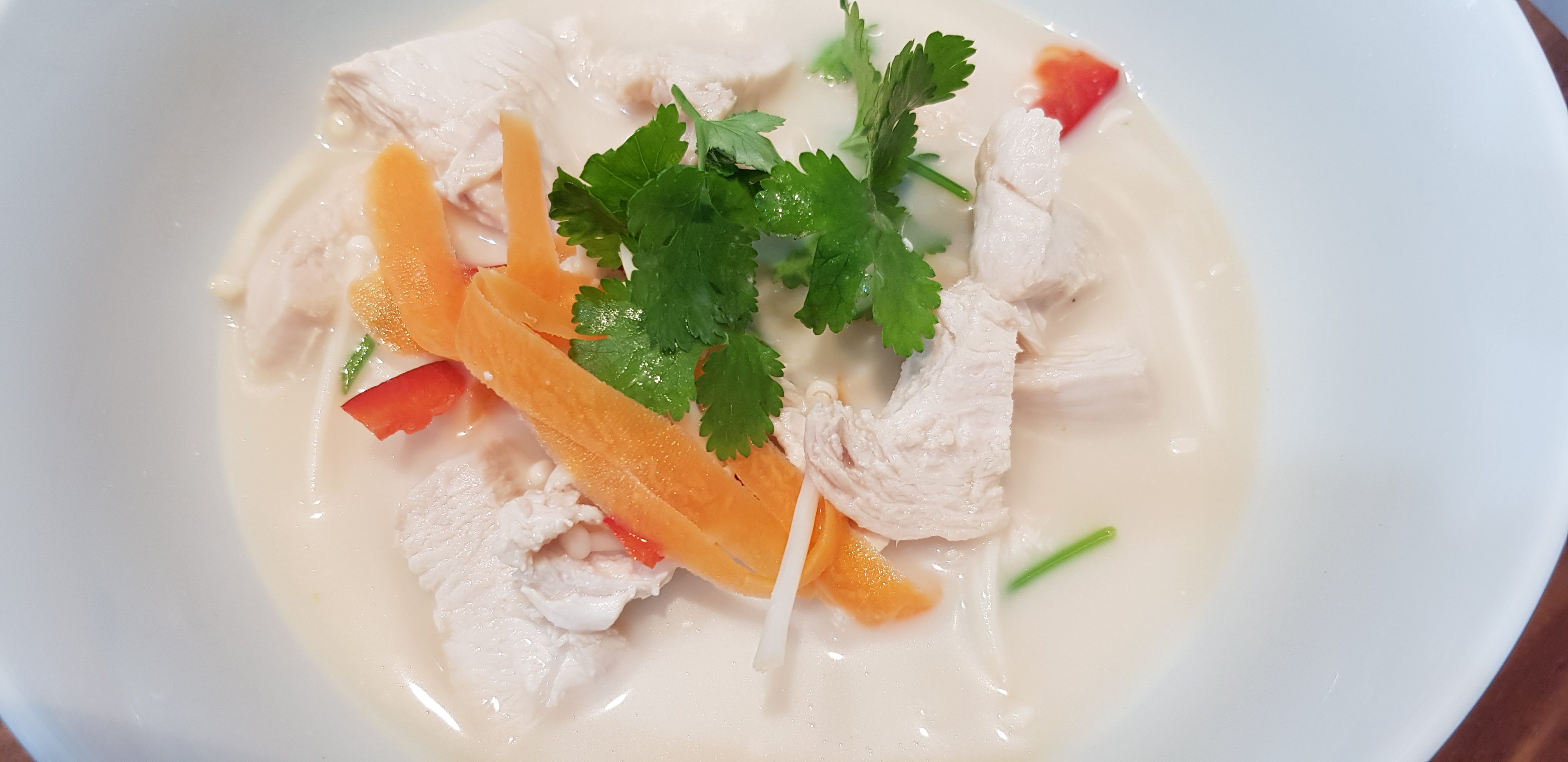
PK’s Simple Tom Kha Gai
My way of making Tom Kha, a Thai coconut, chicken and galangal soup, one bowl at a time is great if you have a family with widely different stands on what they will or won’t eat. For example, I love tomatoes, mushrooms and spring onions so I use lots of them in my bowl. My lads don’t so they get more mushrooms, carrot and corn.
It is also great when you have your friends over for lunch or dinner. Simply put a big pot of soup on the table with the vegetables and rice separate and everyone can build their own bowl. Don’t forget slices of lime, chopped Thai chilies and extra fish sauce. 🙂
Note: I think this makes enough soup for 2 hungry adults.

Steps
- Preparing the ingredients
- Bringing the soup to the boil
- Serving
Ingredients
- 1 poached chicken breast
- 1 small coriander plant (roots and leaves), whole
- 1 chunk of fresh galangal, bruised
- 3 kaffir lime leaves, bruised
- 1 lemongrass stalk, bruised
- 1 Tbsp fish sauce for the pot and 1 Tbsp for each serving bowl
- 1 Tbsp lime juice for the pot and 1 Tbsp for each serving bowl
- 1/2 cup water
- 2 cups chicken stock
- 1 cup coconut milk
- 3 Thai chiles, sliced (optional but encouraged)
- Your personal choice of vegetables
- Coriander leaves to garnish
Equipment
- 1 chef’s knife
- 1 chopping board
- 1 wooden spoon
- 1 saucepan/soup pot
Preparing the ingredients
- Cut your poached chicken breast into cubes or slices.
- Bruise the galangal chunk and the lemongrass stalk and add to the pot.
- Bruise the kaffir lime leaves, or like I have put little tears in the edges to release the flavour better, and add to the pot.
- Add one small coriander plant.
- Add:
- 1 Tbsp fish sauce
- 1 Tbsp lime juice
- 1/2 cup water
- 2 cups chicken stock
- 1 cup coconut milk
- 3 Thai chiles (optional)

Bringing the soup to the boil
- Let everything come to a boil really slowly to infuse all the flavours. I don’t move it very often and then only a gentle swirl.
- Once you have a gentle boil, turn the heat down a bit and add the poached chicken.
- Cook until the chicken is safely warmed through but not for too long or it will go stringy.

Serving
- Build up a bowl of your favourite vegetables and add 1 Tbsp fish sauce and 1 Tbsp lime juice.
- Add some chicken and then add as much soup as you want (liquid only, the rest stays behind).
- Provide your guests with some cooked rice, slices of lime, extra chiles and fish sauce.

Enjoy,
PK
YOU MIGHT ALSO LIKE
MORE THAI DISHES
MORE ASIAN CUISINE
CHICKEN DISHES
MORE SOUP POSTS
Please consider subscribing to a weekly email summary of our posts or check us out on Facebook @growitcatchitcookit.
[mc4wp_form id=”15771″]
Written by
·
-

PK’s Cheaters Red Curry Paste
Here is my, unashamedly, unauthentic red curry paste :).

I use it to make Thai Red Chicken Curries and also Tom Kha Gai (one of my favourite south-east Asian soups).
Please read PK’s Curry Paste Kit before you get going and also ramp the chili factor skywards if you are allowed to. You will notice that I use a blender because I am a lazy cook. However I prefer the chunkier look of the paste if you use a mortar and pestle.
One last thing, I would love to use Kaffir lime zest instead of common limes but my tree never seems to fruit. I think it has something to do with what it is grafted to.
You will need:
- Ingredients:
- 1 Tbsp whole coriander seeds
- 0.5 Tbsp whole cumin seeds
- 1 Tbsp rock salt (add more if you want a more authentic taste)
- 0.5 tsp whole black peppercorns
- 1 Tbsp powdered kashmiri chili (add more and use whole chilis if you want a more authentic taste and look)
- 3 coriander roots
- 7cm of pickled galangal root
- 5 garlic cloves
- 3 lemongrass stalks, freshly harvested, leaves removed
- 1 large red shallot
- 1 Tbsp dried belacan (shrimp paste)
- 1 Tbsp lime zest (I used about 2 small limes to get this much)
- a dash of lime juice
- a dash of water (add less or more depending on your desired consistency)
- a dash of olive oil or garlic infused olive oil (I think you can skip this if you are using a mortar and pestle)
- 2 Kaffir lime leaves (sorry everyone, I know this is really not the done thing traditionally)
- Equipment
- a chopping board
- a sharp knife
- a serving bowl
- a wet blender with a very small bowl
- a dry spice mixer
- a medium frypan (for dry roasting the spices)
Make the paste
I love bringing everything together before I start cooking. The ingredients in this dish are so visually appealing and the aromas are simply amazing.

Steps:
- Dry roast the 1 Tbsp whole coriander seeds, 0.5 Tbsp whole cumin seeds and the 0.5 tsp whole black peppercorns.
- When cooled, pop them in you dry spice mixer and pulse to a rough consistency.
- Chuck the rest of the ingredients (at least roughly chopped) in your wet blender:
- 1 Tbsp powdered kashmiri chili
- 1 Tbsp rock salt
- 3 coriander roots
- 7cm of galangal root
- 5 garlic cloves
- 3 lemongrass stalks
- 1 large red shallot
- 1 Tbsp dried belacan
- 1 Tbsp lime zest
- a dash of lime juice
- a dash of water
- a dash of olive oil or garlic infused olive oil
- 2 Kaffir lime leaves

Storing
This paste freezes well in a small container or snap-lock bag. I prefer to make it in just enough of a quantity so I can use it fresh in a dish.
Enjoy and please send me your tips,
PK
Written by
·
- Ingredients:
-

Galangal (Alpinia galanga)
I was first introduced this root (from the ginger family) when I fell in love with and started cooking Tom yum goong. Tom yum is a Thai soup with a, hard to perfect, balance of hot and sour flavours and is exceptionally high in aromatic and visual appeal. I grow a lot of the ingredients for these soups in my kitchen garden, I like it that much :).

However, I generally buy the whole root (pickled) from my local Asian grocer. In Australia it is often called Galanga. It is also commonly available sliced and vacuum packed in the frozen section.I used to buy Galangal 🙂 now I grow it myself in pots rich in organics and in full sun. When you want to harvest it, pull a chunk out, cut what you want and slap the rest back under the soil. Be as rough as you want, this plant can take it!
I then use it in one of two ways:
- For soups I add it whole (see the picture above) but I bruise it with a rolling pin or score it with a knife to release the flavour. When the soup is done, I chuck the root into the compost bin.
- In pastes I slice it finely first (it is a very hard root and may make the wet blender wobble) and then blend it into the paste.
- Young leaves can be eaten too.
It is true what they say about regular ginger root being a poor substitute as it is much stronger flavoured in my opinion.
From Wikipedia:
Alpinia galanga, (also Languas galanga), a plant in the ginger family, is an herb used in cooking, especially in Indonesian and Thai cuisines. It is one of four plants known as galangal, and is differentiated from the others with the common name greater galangal (or simply Thai galangal).
An example of a live plant in my garden:

The flower is a beauty too:

So easy to split and regrow:

Enjoy,
PK
Related Links:
Please consider subscribing to get a weekly email summary of our posts.
[mc4wp_form id=”15771″]
Written by
·